HUMAN's Device-Graph: The Third Anti-Bot Architecture
Three anti-bot vendors run structurally different architectures: DataDome (behavioral), Akamai (TLS/JA4 fingerprinting), HUMAN (device-graph correlation across millions of trusted devices). Each detects different bypass profiles. The right pick depends on what attack you face.
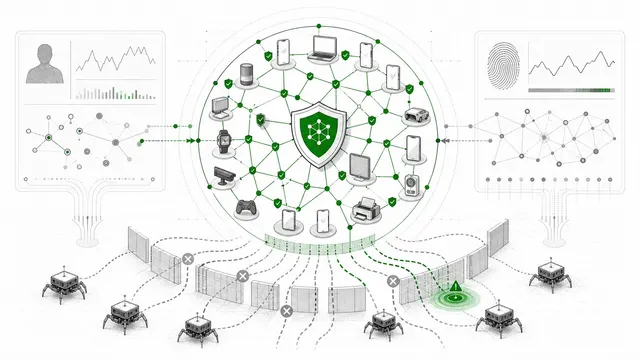

The three anti-bot vendors that dominate the publisher-side market in 2026 — DataDome, Akamai Bot Manager, HUMAN Security — are not direct substitutes. They run structurally different detection architectures, optimized for different attack profiles. A publisher choosing between them is not picking the same product at three price points. They are picking among three approaches to the bot-detection problem that have meaningfully different blind spots.
The architectural distinctions matter because the scraping operators that defeat each architecture do so in different ways. A scraper that bypasses Akamai’s TLS fingerprinting may still get caught by HUMAN’s device-graph correlation. A scraper that defeats DataDome’s behavioral classifier may sail through HUMAN’s perimeter because it operates from devices that HUMAN’s graph trusts.
The three architectures
DataDome — behavioral classification. DataDome’s detection model focuses on request-level and session-level behavioral signals: request timing, navigation patterns, mouse-movement traces (when available), keyboard rhythm, JavaScript-execution fingerprints. The architecture is built around a classification model that scores incoming sessions in real time and serves a challenge (CAPTCHA, payment-wall, block) on suspicious scores. The strength is detecting scrapers that have not invested in human-like behavior emulation. The weakness is that scrapers running real browsers with realistic timing patterns are increasingly difficult to distinguish from real users at the request level.
Akamai Bot Manager — TLS / network fingerprinting. Akamai’s detection model leans heavily on lower-layer signals: TLS handshake characteristics (now JA4 and JA4S), HTTP/2 settings frames, header order, TCP options. The architecture exploits the fact that automation tools (Selenium, Playwright, custom HTTP clients) often have detectable network-stack signatures that genuine browsers do not. The strength is catching scrapers that have not customized their network-stack fingerprints. The weakness is that the major scraping infrastructure (Bright Data, Apify Scraping Browser, Smartproxy/Decodo Scraper, custom Patchright-based deployments) now ships with realistic browser-grade TLS fingerprints by default.
HUMAN Security — device-graph correlation. HUMAN runs a different model entirely. The company maintains a “Human Verification” graph that links observed devices across millions of websites — when a device is observed making realistic human interactions on one site, it accumulates trust score that propagates across the graph. The detection model asks not “does this request look human” but “does this device have a history of being human across other observed surfaces.” The strength is catching scrapers that operate from fresh devices or rotating residential proxies, because those have no trust history. The weakness is that scrapers operating from compromised real-user devices (malware-driven, browser-extension-driven) inherit the trust of the underlying device.
Where each architecture wins
The three architectures produce different detection wins, and the right publisher choice depends on which attack profile dominates the threat model.
Detecting commodity scrapers (low-sophistication, mass-volume). DataDome dominates here. The behavioral model catches anything that does not invest in human-like emulation, which is the bulk of commodity scraping volume. Akamai catches a subset that uses detectable network-stack signatures. HUMAN catches the residential-IP-rotating subset that has no trust history.
Detecting sophisticated headless scrapers (Patchright, Camoufox, custom Chromium variants). Akamai’s TLS fingerprinting is the strongest defense here — these tools customize browser behavior but historically have weaker investment in network-stack-level realism. DataDome catches some via behavioral signals; HUMAN catches some via the no-trust-history pattern. None of the three catches all.
Detecting residential-proxy-based scrapers (Bright Data, Smartproxy/Decodo, NetNut, Soax). HUMAN’s device-graph is the strongest defense. The residential IPs that the proxy networks rent rotate frequently, and most do not accumulate the device-trust history that HUMAN’s graph keys on. DataDome catches a subset via behavioral patterns; Akamai catches a smaller subset.
Detecting browser-as-a-service scrapers (Browserbase, Hyperbrowser, Steel). All three architectures have meaningful gaps here. The BaaS providers ship realistic browser instances with reasonable TLS fingerprints, run from datacenter IPs that have some baseline trust, and are typically driven by AI agents that produce close-to-human behavior patterns. The detection problem is hard for all three vendors, which is why this is the active research frontier in 2026.
Detecting AI agents (Operator, Mariner, Claude with computer use). This is the newest detection problem. The agents run real browsers, produce close-to-human timing, and operate from devices that HUMAN’s graph may have legitimate trust scores for. DataDome’s mid-2025 taxonomy revision added an “AI agents” category specifically to handle this, but the detection efficacy is still maturing across all three vendors.
What the architectural differences imply for buyers
For a publisher evaluating which anti-bot vendor to deploy, the three architectures point at different selection criteria.
Threat model matters more than vendor reputation. A publisher facing commodity scraping should weight DataDome’s behavioral strengths. A publisher facing sophisticated headless tools should weight Akamai’s TLS-fingerprinting depth. A publisher facing residential-proxy-driven scraping should weight HUMAN’s device-graph approach. The “best anti-bot vendor” question is mis-framed; the right question is “which threat profile dominates my logs.”
Multiple architectures may be necessary. Large publishers (top-tier news, top-tier e-commerce) increasingly deploy multiple anti-bot vendors in layered configurations — DataDome at the edge for behavioral signals, Akamai at the network layer for fingerprinting, HUMAN as a deeper-layer correlation check on suspect sessions. The combined defense catches more than any one vendor alone, at the cost of operational complexity and double-paying for the protection.
The detection cost is rising. As scraping infrastructure improves at evading each architecture’s signature detection moves, the vendors are forced to invest in longer-window, multi-signal correlation models. The compute cost of running these models per request is increasing. The pricing on enterprise anti-bot contracts has crept up 20-40% over 2024-2026, even as the underlying request-volume costs technology should make cheaper, because the model sophistication required has more than offset the cost gains.
The implication for scraping operators
For Apify Store publishers building actors that hit publisher sites, the three-architecture map is operational guidance.
A scraper that needs to defeat one vendor’s architecture rarely needs to defeat all three. The publisher’s choice of anti-bot vendor — visible in HTTP response headers, in challenge-page styling, and in the DataDome / Akamai / HUMAN detection patterns documented across the scraping community — determines which evasion approach the scraper needs to invest in.
The longer-term equilibrium points toward layered defenses on the publisher side and layered evasion on the operator side. The straightforward “use Patchright and rotate residential IPs” approach that worked through 2023-2024 increasingly fails against modern stacks because the layered defenses catch what single-vector evasion misses. The economic question for the operator becomes the same one the publisher faces: how much evasion engineering is the data worth.
For the high-value scraping targets (e-commerce inventory, financial market data, real-estate listings), the answer is: a lot. The operators that successfully scrape these targets in 2026 are running custom infrastructure with significant per-target engineering investment. The bulk of the Apify long-tail catalog is scraping lower-value, less-defended targets — which is why the long tail exists. The defenses at the top end of the publisher market are now sufficiently strong that the small-publisher economic case for hand-rolled scraping has shrunk.
What changes next
Three developments visible in the 2026 anti-bot roadmap will reshape the three-architecture landscape.
HUMAN’s expansion into AI-agent detection — using the device-graph trust mechanism to distinguish “human-driven browser” from “AI-driven browser” based on interaction patterns that are subtly different across many surfaces. Expected to ship in a meaningful product release H2 2026.
Akamai’s behavioral expansion — moving beyond TLS into longer-window behavioral signals, partly to address the BaaS detection gap. This pulls Akamai’s architecture closer to DataDome’s, which is the convergence pressure all three vendors are under.
DataDome’s device-correlation features — building a graph similar in concept to HUMAN’s, leveraging the visibility DataDome has across its customer base. Earlier-stage product than HUMAN’s mature graph.
The convergence direction is clear: each vendor is building toward the others’ strengths. By Q4 2027, the three architectures will look more similar than they do today. For now, the architectural distinctions remain the most consequential variable in publisher-side anti-bot vendor selection — and in scraping-operator evasion strategy.
Sources