Apify New Actors: 97% Survive 30d, 3% Cross 100 Users
Of 463 new Apify actors with reliable launch dates, 91-100% are still 'alive' (have users) at each age bucket up to 45 days. Only 2-3% cross 100 users/month in that window. The challenge is escape velocity, not survival. Near-zero plateau is the default.
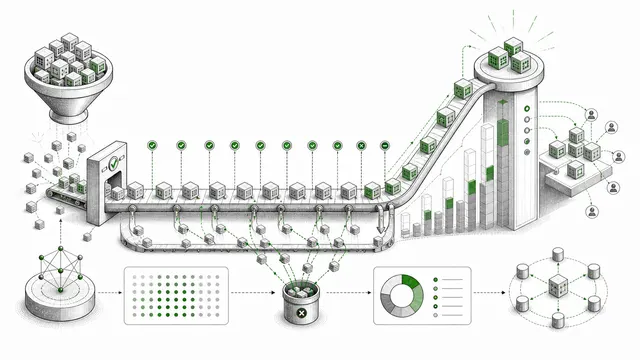

The common narrative around new Apify actors is that most “die” within their first few weeks — abandoned by publishers, ignored by buyers, lost in the catalog. The cohort data tells a different story. Of 463 Apify actors with reliable launch dates in the last 45 days, 91-100% are still alive at each age bucket (have at least one user in the most recent 30-day window). Death is rare. Plateau is the default.
The harder number is on escape velocity: only 2-3% of new actors cross 100 users/month in their first 45 days. The 97% that survive do so at the bottom of the demand distribution. They are alive in the technical sense, contributing zero to the aggregate demand pool the headline actors capture.
The survivor curve
Cohort: 463 Apify actors tracked with observed first_seen quality (clean launch dates, not pre-baseline). Bucketed by days since first appearance:
| Age bucket | Actors | 30d active | 7d active |
|---|---|---|---|
| 0-7d | 90 | 82 91.1% | 79 87.8% |
| 8-14d | 31 | 31 100% | 29 93.5% |
| 15-21d | 70 | 69 98.6% | 58 82.9% |
| 22-30d | 126 | 119 94.4% | 90 71.4% |
| 31-45d | 82 | 79 96.3% | 65 79.3% |
| Age bucket | Actors | Crossed 100 | Cross-rate |
|---|---|---|---|
| 0-7d | 90 | 0 | 0% |
| 8-14d | 31 | 0 | 0% |
| 15-21d | 70 | 0 | 0% |
| 22-30d | 126 | 4 | 3.2% |
| 31-45d | 82 | 2 | 2.4% |
| Six actors crossed 100 users/month in the 8-45 day cohort. | |||
The 30-day “death rate” is 5.6%. The 45-day “death rate” is 3.7%. The variance across buckets is statistical noise, not a trend. The data is clear: new Apify actors almost never go to zero users in their first 30-45 days.
The 7-day-active number (a tighter “currently functioning” threshold) drops more sharply — from 88% at age 0-7d to 71% at age 22-30d, then back up to 79% at age 31-45d. The dip-and-recover pattern suggests that actors find a stable low-demand floor around 1-7 users per week within their first month and then hold there.
The escape-velocity numbers
The harder threshold — actors that actually grow into demand-bearing positions — is the second panel in the cohort table above.
Of 399 actors tracked from 8-45 days old, six crossed 100 users/30d. 1.5% of new actors reach that threshold in their first 45 days. The rest live at the long-tail floor — measurable users but not at meaningful scale.
The 100-users-per-month threshold is generous. The demand distribution shows that getting into the top-1% requires roughly 500+ users/month. Getting into the top-0.1% (the three actors that capture 18.5% of demand) requires 10,000+ users/month. The “1.5% cross 100” figure understates how rare meaningful escape-velocity is.
What the cohort tells you
Three structural implications.
The survival narrative is wrong. Publishers and platform observers who talk about new actors “dying” in their first month are imagining a competitive-marketplace dynamic where unfit actors get pruned. The Apify Store does not prune. There is no churn mechanism on the catalog side — actors that find zero buyers stay listed indefinitely. The 25% zombie rate on the broader tracked subset reflects this: actors do not die; they sit silent.
Time-to-first-100-users is the meaningful metric. Survival is essentially universal at 45 days. Crossing the 100-user-per-month threshold is exceptional. For a publisher, the question is not “will my actor survive” but “will my actor reach the demand floor where the platform’s discovery mechanics start helping me.” The data says: usually no, and quickly enough to recover effort cost.
Cohort-launch positioning matters more than execution after launch. The 1.5% that cross the escape-velocity threshold in 45 days appear to be doing something different at launch — clean target selection, clear naming, schema discipline, immediate listing in a low-competition category. Post-launch optimization (improved README, better error handling, expanded documentation) is not what drives the 1.5%. They were launched well and the discovery mechanics rewarded them quickly. The 98.5% that did not cross did not fix themselves in weeks 2-6.
What this means for new publisher entrants
The survivor-curve data points at a specific publisher posture for new actor launches.
Frontload the positioning work. The launch is the decision point. The first 7-21 days of distribution either produce enough early traction to enter the discovery-mechanic feedback loop or do not. Post-launch optimization is not where new actors typically recover from a weak launch — they just stay at near-zero.
Pick targets with proven escape-velocity history. Categories where the density per actor is high (OPEN_SOURCE, TRAVEL, VIDEOS, SOCIAL_MEDIA) have more buyer-side gravity to lift a new entrant into the 100+ user band. Categories where density is low (AUTOMATION, JOBS, BUSINESS) require a launch that beats hundreds of existing actors before discovery mechanics start helping.
Treat the first 30 days as the decision window. If an actor has not crossed 100 users/30d by day 30, the historical base-rate says it will not cross by day 45 either. The 1.5% that escape do so quickly. Publishers planning around “the actor will grow over 6-12 months” are misreading the cohort — the actors that grow do so in the first 4-6 weeks, not over quarters.
The longer-term shape of the Apify Store economy is consistent with this cohort data. The headline catalog of 25,787 actors is mostly the accumulated record of launches that did not reach escape velocity. The working economy is the small share that crossed early and stayed in the demand-bearing tier. New publishers entering the market should plan to be exceptional at launch, not patient post-launch — because the data says the patient strategy mostly does not work.
Sources
- Apify Store — full catalog
- Signal Census pulse data — 463 actors with reliable observed first_seen dates as of 2026-05-16
- Signal Census: Apify’s Pareto-of-Pareto — demand-distribution context
- Signal Census: Apify’s Zombie Rate — full-catalog active/silent breakdown
- Signal Census: Apify’s Long Tail — broad demand-floor data