Multi-Agent Frameworks Converge on One Orchestration Pattern
AutoGen, CrewAI, LangGraph, Swarm, and AGI Worker present different APIs but ship the same orchestration pattern: typed-role agents passing structured messages with tool-call interruption. Framework choice is now ergonomics. The real question is what runs in the tool layer.
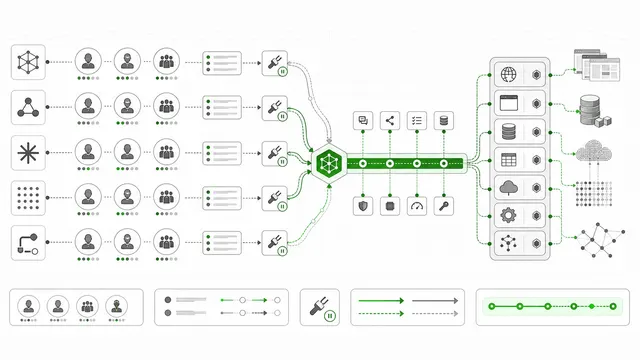
The multi-agent framework landscape in 2026 lists five serious entrants: Microsoft’s AutoGen, CrewAI, LangChain’s LangGraph, OpenAI’s Swarm, and the open-source AGI Worker. The marketing surfaces of the five emphasize different metaphors — autonomous workers, agent crews, state graphs, agent swarms — but the underlying execution architecture has converged on a single pattern.
That convergence is structural, not stylistic. The pattern works because it matches what LLM tool-calling actually does at the API level. The marketing differentiation is real but operates at the ergonomics layer, not the architecture layer. The interesting differentiation has shifted to the tool layer that each framework lets its agents call — and increasingly, what runs at the tool layer is the MCP-served catalogs of scraping infrastructure that Apify, Bright Data, and Firecrawl ship.
The shared orchestration pattern
All five frameworks implement variations of the same execution loop:
- Typed agent roles. Each agent has a system prompt that defines its responsibility, a list of tools it can call, and a model assignment (often differentiated — research agents on cheaper models, decision agents on reasoning-tier models).
- Structured message passing. Agents communicate via typed messages (typically JSON or a Pydantic-style schema) that include role, content, and tool-call metadata. The orchestrator routes messages based on routing rules or based on the agent’s own next-step decision.
- Tool-call interruption. When an agent decides to call a tool, the framework pauses the LLM inference, executes the tool, returns the structured result, and resumes the agent with the result in context. This is identical across all five frameworks because it is identical at the OpenAI/Anthropic/Google API level.
- Termination logic. Each framework defines stop conditions — a task-completion signal from a final-decider agent, a turn-count limit, a budget exhaustion, or an explicit user halt.
The differences across the five frameworks are real:
- AutoGen emphasizes graph-defined agent topologies with named conversation patterns
- CrewAI emphasizes role-based agent definitions with explicit task assignments
- LangGraph exposes the execution loop as a state machine with declared transitions
- Swarm (OpenAI) is intentionally minimal — agents and handoffs, nothing else
- AGI Worker focuses on persistent agent identity across sessions
The differences are at the API ergonomics layer. The actual operations the frameworks perform — LLM call, tool dispatch, result integration, next-step routing — are the same set of operations in the same order. A team that has built around AutoGen and wants to migrate to LangGraph faces a porting cost, not an architectural rewrite.
Why the convergence happened
Three forces pushed the frameworks toward the same shape.
The model API surface is the constraint. OpenAI’s chat-completions API, Anthropic’s Messages API, and Google’s Gemini API all expose tool-calling in substantially the same shape: pass tool definitions, receive tool-call requests, dispatch tools client-side, return results, continue. A multi-agent framework that wants to call any of these APIs has to organize its execution loop around that shape. The frameworks did not choose convergence; the underlying APIs forced it.
MCP standardized the tool layer. Anthropic’s Model Context Protocol put a stable interface between the agent layer and the tool layer. A framework that supports MCP gets the entire MCP-compatible tool catalog for free. All five major frameworks added MCP support during 2025-2026. The tool layer is now a separate, framework-agnostic ecosystem — which means the framework’s job is execution orchestration, not tool integration.
The benchmark scoring metric is the same. OSWorld, WebVoyager, WebArena, Mind2Web — the benchmarks that publish leaderboards and that vendor marketing teams cite — all measure task completion on standardized inputs. The frameworks competing on those benchmarks have to optimize for the same outcome, which produces the same architectural choices.
What the divergence still looks like
Three areas of meaningful framework difference remain:
State management for long-horizon tasks. Agents that need to remember context across hours or days of execution have different solutions: AGI Worker has built-in agent-identity persistence, LangGraph exposes explicit state checkpointing, AutoGen and CrewAI delegate state to the application layer. For multi-day tasks (research projects, long-running scrapers), the state-management choice is the architecturally most impactful framework decision.
Failure recovery semantics. When an agent fails mid-task (tool call returns an error, LLM call hits rate limit, model returns malformed JSON), the frameworks handle recovery differently. LangGraph’s state-machine model makes recovery explicit; Swarm leaves recovery to the application; AutoGen has middle-ground retry semantics. For production reliability, this is where the porting cost between frameworks actually shows up.
Multi-model routing. Production multi-agent systems typically route different agents to different models based on cost/capability trade-offs (e.g. Haiku for research, Sonnet for decision-making, Gemini Flash for high-volume extraction). The frameworks handle multi-model routing with different levels of sophistication. CrewAI and LangGraph have explicit support; Swarm requires hand-rolled integration.
What runs in the tool layer
The framework convergence means the question “which framework should we use” is increasingly less important than “which tools will our agents have access to.” The tool layer is where production multi-agent systems either succeed or fail.
For scraping-adjacent agent workloads — competitive intelligence, lead enrichment, market research, content monitoring — the tool layer is dominated by three providers:
- Apify MCP server — exposes the 20,000+ actor catalog as a discoverable tool list. Pay-per-event pricing, with x402 and Skyfire payment rails for agent-driven purchasing without account creation.
- Bright Data MCP server — fixed tool surface (search, scrape_as_html, scrape_as_markdown, plus dataset-specific tools). Highest measured task success on AIMultiple’s benchmark.
- Firecrawl MCP server — eight focused tools (scrape, batch, crawl, search, extract, map, plus async variants). Cleanest “page in, structured data out” surface.
A multi-agent system orchestrated in any of the five frameworks can call any of these three MCP servers. The framework choice does not constrain which scraping infrastructure the agents have access to. That decoupling is the structural significance of the MCP-era convergence: framework competition has been compressed into ergonomics, and the actual capability differentiation has moved to the tool layer that the frameworks share.
Distribution math for MCP-exposed actors
For Apify Store publishers, the framework convergence has a direct distribution implication. An actor exposed via Apify’s MCP server is callable from agents running in AutoGen, CrewAI, LangGraph, Swarm, AGI Worker, and any future framework that respects the MCP protocol. The historical model of “build an integration per platform” is gone. The new model is “build for MCP, distribute everywhere.”
The competitive risk runs the other way: an actor that does not expose itself well at the MCP tool-discovery layer (clear input schema, machine-readable description, predictable output shape) is invisible to the agent-driven buyer regardless of the framework the agent uses. The Apify Store’s machine-readable surface — schema discipline, tag focus, clean output — is now the discovery surface for the entire multi-agent ecosystem, not just for the Apify-platform user.
The framework consolidation that produces convergent orchestration also produces a convergent buyer profile: an agent that picks tools by typed signature and observed cost. For publishers, that is both a distribution opportunity (one MCP integration, five-framework reach) and a quality-bar increase (the same buyer profile evaluates every actor by the same criteria). The publishers who optimize for the multi-agent buyer’s evaluation criteria will capture the share that the publishers ignoring it leave on the table.
Sources