ParseHub, Webscraper.io, Zyte: The Legacy Tier in 2026
Three names dominated 2018-era scraping listicles: ParseHub, Webscraper.io, ScrapingHub (now Zyte). Eight years on, Zyte is the only one growing — repositioned as enterprise data-as-a-service. The other two coast on legacy product surfaces with no expansion path.
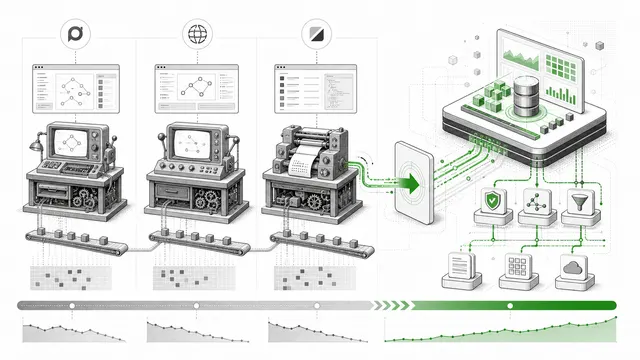

Three vendors anchored the 2018-era “best web scraping tools” listicles: ParseHub (visual scraper desktop app), Webscraper.io (browser-extension freemium), and ScrapingHub (the company behind Scrapy, now rebranded Zyte). Eight years on, the trajectory of each maps cleanly to one of three legacy-vendor failure modes — and to one survival pattern.
Zyte made it through. ParseHub and Webscraper.io did not. The reasons are not specific to those companies; they are general to the 2010s-era scraping-vendor business model in the AI-agent era.
The three trajectories
The eight-year update:
Zyte (formerly ScrapingHub, founded 2010). Rebranded from ScrapingHub to Zyte in 2020. Now positioned as an enterprise data extraction platform — fully managed, AI-augmented, with SOC 2 and ISO 27001 compliance. Maintains the open-source Scrapy framework but the commercial business is no longer about hosted Scrapy. Pricing is enterprise-only, with deal sizes from low-five-figures to seven-figure annual contracts. Hiring continues. Customer logos include large media, e-commerce, and finance buyers.
ParseHub (founded 2013). Still operational. Free tier preserved (5 public projects, 200 pages per run). Paid tiers at $189-599/month. Product evolution since 2020 has been minimal — the same desktop visual-builder interface, the same cloud-runner, the same export formats. No public information about funding rounds since the 2017 seed. No published customer wins of note. The business appears to be running on the existing customer base, with limited new-customer acquisition.
Webscraper.io (founded ~2014). Browser extension plus a SaaS cloud-runner. Freemium model with $50-200/month paid tiers. The extension itself still has 250k+ Chrome Web Store users — a real distribution asset. But the cloud-runner business has not scaled to meaningfully monetize that distribution. The product hasn’t materially changed in 2-3 years.
What separated the survivor
Zyte’s survival came from three repositioning moves the other two did not make.
Moving up-market. ParseHub and Webscraper.io stayed in the self-serve, small-buyer band ($50-600/month). Zyte abandoned that band entirely between 2020 and 2024 and rebuilt the business around enterprise contracts. The unit economics of the enterprise band are dramatically better — single deal sizes that exceed the small-buyer band’s annual revenue.
Abandoning the framework as product. Zyte continues to maintain Scrapy as an open-source project, but the commercial business is no longer “hosted Scrapy as a service.” It is data extraction outcomes for enterprise buyers, with Scrapy as one of several underlying technologies. The other two stayed attached to their original product surface — visual builder, browser extension — which limits the addressable market to the buyers who want that specific surface.
Building compliance and SLA scaffolding. Enterprise buyers require SOC 2, ISO 27001, GDPR documentation, defined SLAs, and dedicated support. Zyte built all of that. Neither ParseHub nor Webscraper.io has equivalent compliance posture, which structurally locks them out of the enterprise band where the money is.
The common factor across the three failures-to-grow (ParseHub plateau, Webscraper.io plateau, smaller legacy names that have wound down entirely) is the same: a 2010s product surface, designed for individual operators or small teams, that did not get re-platformed for the buyer profile that actually has scraping budget in the 2020s.
What the legacy tier signals
For an Apify Store publisher or any new scraping-vendor entrant, the legacy-tier trajectories are an early-warning system on three patterns.
Visual-builder lock-in is not durable. ParseHub’s visual scraping interface looked like a moat in 2017 — non-developers could use it. By 2026, the same non-developer demographic that would have used a visual builder is using an LLM-powered scraping tool (Firecrawl, Apify’s AI Crawler, Bright Data’s Web Unblocker via natural-language prompt). The visual-builder UX is no longer the lowest-friction option.
Browser-extension distribution is not a business. Webscraper.io’s 250k Chrome Web Store users are a real number, but the conversion rate from “extension user” to “paid cloud-runner customer” is structurally low. The extension solves the local-machine scraping problem; the cloud-runner solves a different problem (scale, reliability) that most extension users do not have.
Standing still is regression. Both ParseHub and Webscraper.io shipped genuine improvements in their first few years and then largely stopped. In the scraping market, “shipping the same product for three years” is regression — competitors are shipping AI-augmented features, anti-bot updates, and integration tooling continuously. The buyer-side perception of “current vs legacy” is keyed to release cadence.
The Zyte counter-pattern is the survival recipe: re-platform every 3-5 years, move up-market when the small-buyer band commoditizes, and build compliance scaffolding before the enterprise buyers ask for it.
The implication for current scrapers
The current generation of Apify Store publishers — many of whom built their actor portfolios in 2022-2024 — face the same structural pressure ParseHub faced in 2018. The product surface that worked when the actor launched will not work the same way in 2027. The publishers who treat their actor as a static product will repeat ParseHub’s trajectory. The publishers who treat the actor as a starting position and continuously re-platform — adding LLM-augmentation, improving schemas, expanding target coverage — will repeat Zyte’s.
The vendor-shutdown frequency in the scraping space is increasing, not decreasing. Reworkd shut down in February 2025 after raising at peak. The graveyard of 2024-2026 will include several more names that look healthy today. The pattern that distinguishes survivors from the graveyard is the same now as it was in 2018: continuous re-platforming, willingness to abandon the original product surface, and a serious read on which buyer segment will pay enterprise rates next.
ParseHub and Webscraper.io are not dead. They are just no longer relevant to the scraping market’s actual growth. That is the slow-death failure mode the current generation should be measuring itself against, not the dramatic-collapse mode that Reworkd represents.
Sources
- Zyte company page
- ParseHub pricing
- Webscraper.io pricing
- Scrapy open-source project
- Signal Census: Reworkd Shutdown — recent vendor failure mode
- Signal Census: Firecrawl Series A — current-generation entrant