Proxy GB Price Floor Convergence: Q4 2024 to Q2 2026
Residential proxy $/GB floor across top-10 vendors compressed from ~$10 (2023) to ~$3 (Q2 2026) at entry tier. Datacenter floor ~$0.50/GB. Bright Data PAYG from $0.60, enterprise from $0.42. Race-to-bottom has structural limits — participant compensation sets a floor.
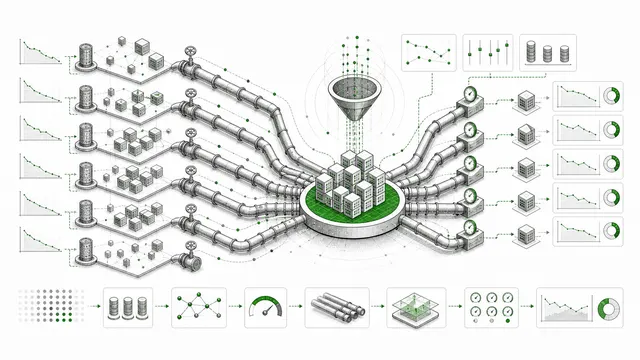

The residential proxy GB price floor across the top-10 commercial vendors has compressed sharply through 2024-2026. Entry-tier prices that were $8-12/GB in 2023 have moved to $2-5/GB in Q2 2026, with the lowest published headline at roughly $0.42/GB for Bright Data enterprise tier. Datacenter proxy pricing has compressed even more aggressively, with floors now sub-$0.50/GB across the major vendors.
The race-to-bottom has structural limits. Residential proxy bandwidth carries real cost — compensation to network participants (the device-owners whose connections are used) plus operational infrastructure for routing and management. Below roughly $0.40/GB at the enterprise tier, the unit economics break for honest providers. The vendors quoting prices below that floor are either operating temporarily at a loss to grab share, depending on opaque sourcing, or charging hidden costs elsewhere.
The market action is at the floor: top-tier headline prices still vary, while enterprise and low-end bands compress toward structural cost.
The pricing trajectory
Approximate residential proxy entry-tier pricing across the top-10 vendors, normalized to USD per GB:
| Vendor | 2023 entry $/GB | Q4 2024 $/GB | Q2 2026 $/GB |
|---|---|---|---|
| Bright Data | $10.50 | $8.40 | |
| Oxylabs | $10.00-15.00 | $8.00 | |
| Smartproxy/Decodo | $8.50 | $7.00 | |
| NetNut | $9.00 | $6.50 | |
| Soax | $9.50 | $7.50 | |
| IPRoyal | $7.00 | $4.50 | |
| Webshare | $3.00 (low-end) | $2.50 | |
| Rayobyte | $5.00 | $4.00 | |
| ProxyEmpire | $6.00 | $4.50 | |
| Stormproxies | $7.00 | $5.50 |
The compression is consistent across the top-tier (Bright Data, Oxylabs) and the second-tier (Smartproxy/Decodo, NetNut). The second-tier moved more aggressively because they did not have brand-price-power to defend. The third-tier (Webshare, Rayobyte) hit the price floor faster because they started lower.
The headline tier-1 prices (Bright Data $5.88-10.50 standard) mask significantly more aggressive enterprise pricing. Enterprise contracts with committed volume can drop to $0.42-0.60/GB at the largest buyers. The 10-25× discount from headline to enterprise rate is structural — the buyer profile that consumes 10TB+/month gets pricing that is operationally impossible to extend to the self-serve buyer at single-GB scale.
What drove the compression
Three forces pushed the floor downward over the period.
Datacenter substitution where possible. As anti-bot defenses became more sophisticated, datacenter IPs are blocked on more targets than they were in 2022-2023. But where datacenter still works (B2B sites, most non-consumer-facing surfaces, many APIs), buyers shifted from residential to datacenter aggressively because the cost difference is 10-20×. The reduced residential demand at the bottom-quality tier put downward pressure on residential pricing.
Mobile-proxy entry pressure. New mobile-proxy vendors (Lunarproxy, Massive, others) launched at $8-15/GB price points in 2024-2025, well below the $20-30/GB that mobile commanded in 2022. The mobile category’s lower premium pulled the residential category down as buyers cross-shopped.
Foundation-lab demand growth. AI crawler traffic to publisher sites grew sharply through 2025-2026. The foundation labs and AI-product vendors negotiated enterprise residential proxy contracts at deep discounts to support training-data acquisition. The enterprise-rate compression pulled the published rates down through cross-tier discovery (buyers learned that the enterprise rate existed and demanded similar terms).
The structural floor
The $0.40-0.60/GB enterprise floor reflects three load-bearing cost components.
Network-participant compensation. Residential proxy vendors pay device owners (via VPN service partnerships, “free” app monetization, or direct compensation) for the bandwidth they consume. The compensation rates are real costs that cannot go to zero. For a vendor sourcing residential bandwidth honestly, the participant compensation is roughly $0.10-0.20/GB.
Routing and management infrastructure. Running a global residential proxy network requires routing infrastructure, session management, IP rotation logic, and customer-facing API services. The per-GB amortized cost is roughly $0.05-0.10/GB at scale.
Compliance and customer support overhead. The legal and operational overhead for serving regulated commercial buyers (financial services, AI labs, enterprise procurement) adds another $0.05-0.15/GB.
Sum: roughly $0.20-0.45/GB minimum honest cost. Below $0.40/GB, the vendor is either operating below cost (unsustainable), sourcing from opaque or unauthorized channels (legal exposure), or making the money back on adjacencies (Web Unblocker upcharge, dataset bundle pricing, scraper-as-a-service margins).
The vendors that have settled into the $0.42-0.60/GB enterprise band are operating at the realistic floor. Further compression at that band is not economically sustainable without restructuring how residential bandwidth is sourced.
What the convergence means for the market
Three implications.
The proxy product is commoditizing. When the top-tier vendors and the second-tier vendors quote within 30-40% of each other on enterprise contracts, the buyer’s selection criterion moves from “who has the cheapest GB” to “who has the cleanest infrastructure for my workload.” Brand, geographic coverage, compliance posture, SLA terms — all become relatively more important.
Vendor margin pressure pushes upstack. The Smartproxy → Decodo rebrand is the canonical example. Vendors that cannot defend margin on raw bandwidth are repositioning as full-stack scraping platforms where the GB pricing is a loss-leader for higher-margin Web Unblocker, dataset, and AI-parser products. Most major vendors have made this move; the ones that haven’t are getting squeezed.
The third-tier resellers face existential pressure. Webshare, IPRoyal, smaller resellers that compete primarily on price have less and less room to differentiate. As Bright Data’s PAYG and Oxylabs’s flexible pricing meet them in the $1-3/GB band, the historical “5× cheaper than top-tier” positioning disappears. Expect consolidation in this segment over 2026-2027.
For Apify Store publishers building actors that need proxy infrastructure, the compression is good news for actor unit economics. The 2-3× drop in residential proxy cost across the typical purchase tier directly improves per-actor margin or supports more aggressive PPE pricing. Publishers who haven’t repriced their actors to reflect the lower input cost are leaving margin on the table for buyers who shop around.
The longer-term trajectory points at further compression in the upper tiers (Bright Data, Oxylabs continuing to discount enterprise rates) and convergence in the entry tier (Webshare, IPRoyal floors flattening around $2-3/GB). The floor at the structural minimum (~$0.40/GB) is probably reached at the enterprise tier by H2 2026 and held there for the foreseeable future. The competitive action moves above the proxy layer.
Sources
- Public pricing pages across 10+ residential proxy vendors (Bright Data, Oxylabs, Smartproxy/Decodo, NetNut, Soax, IPRoyal, Webshare, Rayobyte, ProxyEmpire, Stormproxies)
- Bright Data pricing page
- Signal Census: Smartproxy/Decodo Pivot
- Signal Census: Scraping Pricing Fragmentation