Agent Benchmarks vs Production: The 20-Point Reality Gap
Browser-agent benchmarks (OSWorld, WebVoyager, WebArena) show top scores 66-87%. Production agent reliability lands at 45-55%. The 20-point gap is structural — benchmarks miss adversarial conditions, cost constraints, sustained-reliability. Discount benchmark numbers by ~20pts.
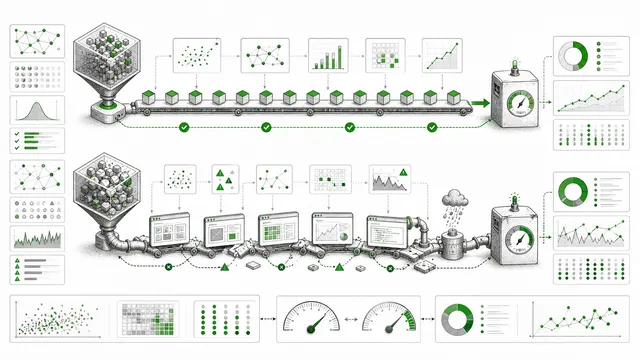
The major browser-agent benchmarks — OSWorld at top-agent 66%, WebVoyager at 85%+, WebArena at 65-70% — consistently report scores that production deployments do not match. Operations running browser-agent workloads against real targets report sustained reliability in the 45-55% range, not the 65-87% range the benchmarks predict.
The 20-point gap is structural. Benchmarks measure single-attempt task success on standardized inputs with unlimited compute budget. Production measures sustained success across thousands of runs against changing inputs with strict cost constraints. The two metrics are measuring different things and the gap reflects what the benchmarks systematically exclude.
What benchmarks measure
The three major browser-agent benchmarks share several methodological choices that produce optimistic numbers relative to production reality.
Single-attempt scoring. OSWorld and WebArena typically score one attempt per task. The agent’s best run determines its score. Production deployments measure success rate across the full distribution of attempts, including the bad runs. A 66% benchmark score with 30% variance can produce a 45% production reliability number once the bad runs are counted.
Pre-tested target sites. Benchmark tasks run against specific URL patterns that the benchmark authors validated as agent-accessible. Anti-bot defenses, geo-restrictions, A/B-tested layouts, and the broader population of real-world target sites are excluded. Production agents face all of these and degrade accordingly.
Unlimited compute budget at scoring time. Benchmark submissions typically run the highest-capability model with the largest context window and longest reasoning time per task. The cost-per-task is irrelevant to the score. Production agents have cost constraints that force smaller, faster models, which score 10-25 points lower on the same task.
Static task definitions. Benchmarks freeze the target sites and tasks at evaluation time. Production agents operate against targets that change — sometimes mid-run. The benchmark does not measure agent robustness against this kind of change.
What production measures
Production agent reliability metrics, by contrast, capture different dynamics.
Sustained run reliability. Production agents typically run thousands to millions of attempts per workload. The reliability number is the fraction of attempts that produce usable output. This is a long-tail-sensitive metric — a few rare failure modes that produce 1% of attempts each can drag the aggregate number down meaningfully.
Cost-constrained execution. Production deployments cap per-task spend. An agent that would score 75% on OSWorld using Claude Opus 4 at $2/task gets deployed on Gemini Flash 2.5 at $0.0007/task, where it scores 55%. The production-relevant number is the score at production-affordable cost, not at benchmark-leading cost.
Adversarial conditions. Real target sites have anti-bot defenses, CAPTCHAs, rate limits, geographic restrictions, login walls. Production agents have to handle these correctly. Benchmark tasks mostly do not include them.
Time-to-completion constraints. Production workloads typically have wall-clock budgets per task. An agent that takes 5 minutes to complete a task is not viable for many production use cases even if it reaches 90% success. Benchmark scoring does not penalize slow agents.
The 20-point gap in detail
Mapping the gap from benchmark to production for a representative browser-agent workload:
| Source of gap | Impact range | Points |
|---|---|---|
| Single-attempt vs sustained reliability | -3 to -5 | |
| Pre-tested vs real-world target distribution | -5 to -10 | |
| Unlimited vs production-affordable model tier | -10 to -15 | |
| Static vs changing target sites | -2 to -5 | |
| Benchmark exclusion of anti-bot defenses | -3 to -7 | |
| The ranges overlap, so the observed production discount is closer to 20 points than the raw sum. | ||
Sum: roughly 23-42 points of gap, of which the empirically observed 20-point gap is the partial overlap (many of these effects are not additive). The detailed decomposition matters because it tells the buyer which gap components are addressable and which are not.
Addressable. The cost-constrained execution gap (10-15 points) can be partially closed by using better-tuned smaller models, by caching, and by hybrid architectures that fall back to expensive models only on hard tasks. Some production deployments have closed 5-10 of the cost-related points by careful engineering.
Partially addressable. The single-attempt-vs-sustained gap can be closed by adding retry logic, voting across multiple attempts, and human-in-the-loop fallback on low-confidence outputs. The production reliability of well-engineered systems can climb 3-5 points above the naive expected value.
Structural. The real-world target distribution gap and the anti-bot defense gap are not addressable from the agent side. They require the benchmark to evolve. As benchmarks add adversarial conditions (some of the newer ones — Mind2Web Live — are trying), this gap will close from the benchmark side over time.
What this means for buyer expectations
For Apify Store publishers, agent-tool buyers, and operations teams evaluating browser-agent deployments, the practical guidance is to discount published benchmark scores by 20 points when forecasting production performance.
Headline 75% → expect 55% in production. A vendor citing a 75% benchmark score is not lying, but the score does not translate directly to production reliability. The buyer should plan for ~55% sustained reliability and architect for the 45% that will require retries, fallbacks, or human review.
Compare benchmark-to-production curves, not point scores. Vendors that publish production-reliability data alongside their benchmark scores deserve preferential consideration. Vendors that publish only benchmark scores should be treated as having unknown production performance.
Multi-model hybrid architectures are where production wins. The cost-tier vs capability-tier tradeoff that drives the largest part of the gap is addressable by combining models — Flash-tier for routine extraction, reasoning-tier for hard tasks. Vendors that ship this hybrid architecture out-of-the-box save the buyer the integration work.
What changes the gap
Three developments visible in the 2026 benchmark roadmap will partially close the gap.
Cost-aware leaderboards. OSWorld and the other benchmarks are under pressure to publish cost-normalized scores (success rate per dollar spent) alongside the headline capability scores. When this becomes standard, the cost-tier mismatch problem becomes visible at evaluation time, and the buyer’s translation from benchmark to production becomes more direct.
Adversarial-condition benchmarks. Mind2Web Live, WebVoyager Adversarial, and other variants that include anti-bot defenses, CAPTCHA challenges, and login walls in the task distribution are emerging. These will give buyers a more realistic capability picture but will also produce lower headline scores that vendors will resist.
Sustained-reliability benchmarks. A benchmark that measures reliability across 10,000 attempts of the same task class, rather than single-attempt success, would directly measure the production-relevant metric. No major benchmark currently does this; the methodology is debated. Expect at least one to ship in 2026-2027.
The 20-point gap is the most informative single number for understanding the current state of agent technology. The headlines from foundation labs about agent capability are accurate as far as they go but do not predict production reliability. Buyers who internalize the gap make better procurement decisions. Buyers who do not internalize it consistently over-buy capability they cannot actually deploy in production.
The longer-term direction of travel is convergence — benchmarks become more production-realistic, production agents close some of the addressable gap, and the headline numbers eventually match the operational reality. The convergence point is probably Q4 2027 to Q2 2028. Until then, the 20-point discount remains the practical buyer rule.
Sources