RealtyMole, ATTOM, CoreLogic: Property Data Wholesale 2026
ATTOM (~150mn US property records), CoreLogic (~99mn), RealtyMole (~155mn, API-first) form the property-data wholesale tier under Zillow. Enterprise pricing opaque ($50-500k/yr typical). RealtyMole's API-first model is 10× cheaper but lighter on analytical depth.
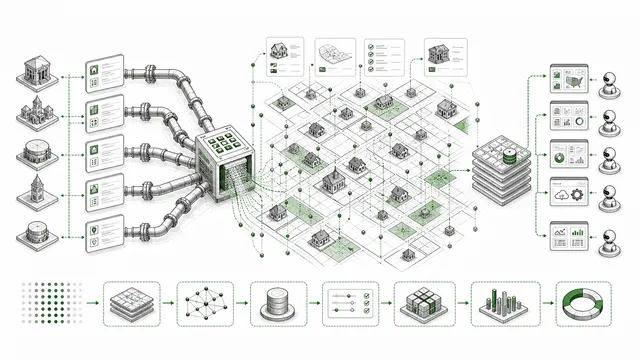

The US property-data wholesale market sits underneath Zillow’s public-facing search surface. The three vendors that matter at enterprise scale are ATTOM Data, CoreLogic, and RealtyMole — and they sit at very different price points despite covering substantially the same property records. ATTOM and CoreLogic dominate by coverage and analytical depth, with enterprise contracts typically in the $50k-500k annual range. RealtyMole undercuts by roughly 10× via an API-first pricing model that surfaces unit costs publicly and serves a self-serve developer audience that the legacy vendors do not.
The price gap reflects what the bundle around the raw data is worth. ATTOM and CoreLogic include human-curated valuations, ownership history, mortgage analytics, and SLA-backed enterprise support. RealtyMole sells the underlying records at API-call pricing without the analytical layer. The same buyer profile that chose Crunchbase Pro over PitchBook enterprise is making the same trade here.
The three vendors
ATTOM Data Solutions. ~150mn US property records covering assessments, deed transfers, foreclosure history, mortgage data, school district overlays. Enterprise-only commercial pricing, with annual contracts typically $50k-300k for mid-sized real-estate buyers. The product positions as the multi-source property analytics platform — combines tax-assessor data, MLS feeds, and demographic overlays into a normalized database.
CoreLogic. ~99mn US residential properties. Stronger position in mortgage/risk analytics than in raw property data. CoreLogic’s underwriting analytics dominate the mortgage industry; the property-record side of the business is the supporting infrastructure. Pricing typical for enterprise-grade real-estate analytics: $100k-500k annual contracts for mortgage-industry buyers, lower for narrower use cases.
RealtyMole. ~155mn US properties via API. Public pricing tiers ($49-499/month for self-serve, custom for enterprise). The product is closer to “raw API access to property data” than to “analytics platform.” Developer-friendly, fast integration, but the analytical layer that ATTOM and CoreLogic include is absent.
What the price differential buys
The 10× pricing gap between ATTOM/CoreLogic and RealtyMole is paying for three concrete things.
Analytical depth. ATTOM and CoreLogic’s valuations include comparable-sales analysis, neighborhood-trend modeling, and risk-adjustment factors that require ongoing analytical work. RealtyMole’s data is closer to raw — tax assessment, ownership, basic property characteristics. Buyers who need analytical outputs do that work in-house when buying from RealtyMole.
Refresh cadence and SLA. Enterprise property-data buyers (banks, insurers, mortgage originators) need data refreshed daily and need SLA-backed uptime guarantees. ATTOM and CoreLogic ship this. RealtyMole’s tier-based pricing includes lower refresh cadence and limited SLA guarantees at the self-serve levels.
Compliance documentation. GLBA, CCPA, and various state-level real-estate regulations apply to property data with PII content. ATTOM and CoreLogic provide compliance documentation that buyers can use in their own regulatory reporting. RealtyMole has compliance posture but it is lighter-weight, suitable for developer use cases but not for institutional compliance reviews.
The buyer who needs all three (depth, SLA, compliance) cannot use RealtyMole and pays the ATTOM/CoreLogic price. The buyer who needs just the raw data and can do the rest in-house gets 10× cheaper pricing via RealtyMole.
How Apify REAL_ESTATE actors fit
The Apify REAL_ESTATE category sits below all three of these wholesalers. The category contains 2,016 actors with 13,571 monthly active users (per the Q2 2026 pulse data) — a thin per-actor demand band of 6.7 users per actor, well below the cross-category median.
Three sub-segments dominate the REAL_ESTATE category:
- Zillow / Redfin / Realtor scrapers that bypass the public-facing rate limits of those sites
- MLS-targeted scrapers that try (with limited success against the Zillow MLS moat) to extract listing data from MLS-protected surfaces
- Specialty market scrapers (Rightmove for UK, regional sites for non-US markets)
The relationship to the wholesale tier is informative. An Apify scraper covering Zillow at moderate volume can deliver property data at $0.001-0.005 per record. That is 100× cheaper than RealtyMole’s API-first pricing and 1,000× cheaper than ATTOM/CoreLogic’s enterprise-tier pricing. The scraping output is also dramatically lower-quality — selectors break, coverage is incomplete, no analytical layer, no SLA.
The buyer who needs property data has four price tiers to choose from:
- Apify-class scraping at $0.001-0.005/record (raw, brittle, no SLA)
- RealtyMole API at $0.01-0.05/record equivalent (clean, basic, light SLA)
- ATTOM / CoreLogic enterprise at $0.10-1/record equivalent (analytical, full SLA)
- Custom panel data at $1-10/record (bespoke, full enterprise)
The price gradient reflects the work being absorbed. Each tier handles less in-house data engineering at higher cost. The Apify tier requires the buyer to do the most work; the custom-panel tier requires them to do almost none.
What it means for the wholesale tier
For ATTOM and CoreLogic, the pressure from RealtyMole + Apify-class alternatives is real but not existential. The institutional buyer profile (banks, insurers, mortgage originators) cannot move to either alternative because the compliance and SLA requirements don’t translate. The self-serve developer buyer (real-estate startups, proptech, analytical tools) moves to RealtyMole or Apify, but that segment was never a meaningful share of ATTOM/CoreLogic revenue.
For RealtyMole, the structural threat is from the Apify-class alternatives compressing the floor. As scraper quality improves and as compliance posture becomes documentable on cheap infrastructure, the gap between “RealtyMole API” and “well-engineered Apify scraper” narrows. RealtyMole’s value proposition has to keep moving upmarket toward where ATTOM and CoreLogic sit, or risk getting squeezed by the marketplace tier.
For Apify Store publishers in the REAL_ESTATE segment, the practical opportunity is in serving the buyer cohort that needs more than what scrapers deliver but cannot justify enterprise pricing. The orchestration layer that combines scraping + light analytical work + reasonable SLA could capture share from RealtyMole at a price point well below the enterprise tier. This is the labor-intel wholesale pattern applied to real estate — building analytical product on top of cheaper underlying data.
The longer-term shape of the property-data market mirrors the broader scraping landscape. Collection is becoming commodity. The value is in the analytical layer above it. ATTOM and CoreLogic have spent decades building that analytical layer; RealtyMole is building it now; Apify-class publishers will start building it next. By 2027-2028, expect a fourth credible vendor in this market built on the scraping-plus-LLM-analytics pattern that the existing wholesale tier was not designed for.
Sources
- ATTOM Data Solutions
- CoreLogic enterprise products
- RealtyMole API documentation
- Signal Census: Zillow MLS Moat
- Signal Census: Labor-Intel Wholesale Stack — adjacent enterprise-data pattern
- Signal Census: Apify Category Growth Race — REAL_ESTATE category context