Similarweb vs Semrush: One Public Read Left
The side-by-side resolved itself: Adobe closed its $1.9bn cash purchase of Semrush in April 2026, so Similarweb is now the only independent public gauge of demand for crawl-based intelligence, and it is finally turning a profit.
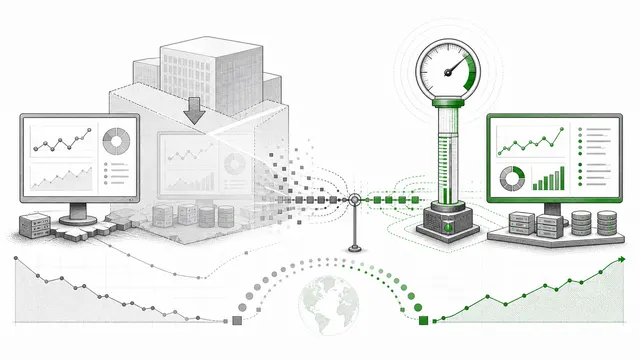
The cleanest way to read demand for crawl-based web intelligence used to be a two-stock comparison. As of late May 2026, it is a one-stock comparison: Adobe completed its $1.9bn all-cash acquisition of Semrush on 28 April 2026, and the shares were pulled from the New York Stock Exchange before the market opened that day. The healthier business was bought; the survivor is the one still proving it can stand alone.
That leaves Similarweb (NYSE: SMWB) as the only listed pure-play whose product is built end-to-end on large-scale web crawling and measurement. Its first-quarter 2026 numbers, reported on 13 May, show a company that has finally crossed into profitability — modestly, and against a softening retention backdrop.
Adobe’s $12 cash bid closed the comparison
Adobe agreed to buy Semrush in November 2025 at $12.00 per share, an all-cash transaction worth roughly $1.9bn in equity value and a 74% premium to the $6.89 close the day before the announcement. The merger completed on 28 April 2026, folding Semrush’s SEO and generative-engine-optimisation data into Adobe Experience Cloud and delisting the ticker.
Semrush walked into that deal as the stronger operator. Its last independent report — fourth-quarter and full-year 2025, published 2 March 2026 — showed full-year revenue of $443.6mn, up 18% year on year, and fourth-quarter revenue of $117.7mn, up 15%. Annual recurring revenue reached $471.4mn at year-end, up 15%, with AI-specific products climbing past $38mn in ARR from $4mn a year earlier. The company was already self-funding: full-year non-GAAP operating income of $53.3mn at a 12% margin, and $59.6mn of operating cash flow.
Strong growth plus real cash generation is the profile a strategic acquirer pays a premium for. Semrush did not get to keep reporting; it cancelled its first-quarter 2026 call and withdrew guidance once the deal was pending. The market resolved the comparison before the analysts could.
What Similarweb’s Q1 actually says
Similarweb posted first-quarter revenue of $73.9mn, up 10% from $67.1mn a year earlier. The more important line sits below revenue: non-GAAP operating profit of $2.4mn, a 3% margin, against a $1.3mn loss in the prior-year quarter. GAAP operating loss narrowed to $4.4mn from $9.3mn, and the company logged its tenth consecutive quarter of positive normalised free cash flow, at $6.6mn.
For a business that came public in 2021 well short of profitability, that is the structural shift that matters. Management now guides to full-year revenue of $307mn–$315mn and $17mn–$19mn of non-GAAP operating profit for 2026 — a first full year clearly in the black on that measure.
Set the two side by side and the divergence is stark. Semrush exited as an 18%-grower at a 12% non-GAAP operating margin; Similarweb is a 10%-grower targeting a roughly 6% operating margin at the midpoint of its guide. On growth and profitability, the company that got acquired was the healthier read on demand for crawl-based intelligence. Similarweb is the cheaper, slower, late-to-profit one — its market value, about $367mn in late May 2026, sits roughly 77% below where it floated.
The retention crack under the surface
Profitability is improving as customer economics soften, and that tension is what to weigh in the quarter. Net revenue retention fell to 98% across all customers, from 101% a year earlier, and to 103% among customers spending more than $100,000 a year, down sharply from 111%. Below-100% blended retention means the existing base is contracting before new logos are counted.
Similarweb is leaning on contract structure to steady the ship: 64% of total ARR is now under multi-year subscriptions, and the count of customers above $100,000 in ARR rose 12% to 461. Longer contracts buy visibility, but they do not reverse a retention rate that has slipped below break-even. That is the number to watch, not the headline growth rate.
Does AI eat this category or feed it?
The bear case on both companies has always been that AI-generated answers collapse the search-and-traffic-analytics market they sell into. Similarweb’s first quarter offers the counter-evidence its management wanted. The company signed a seven-figure LLM training-data contract with an existing big-tech customer in the quarter and expanded an AI-agent data partnership embedding its traffic and keyword datasets into a third-party product.
The logic runs in one direction: a web measured by crawlers is the raw material models need to be trained and grounded, so the same AI wave that threatens the analytics seat could expand the data-licensing one. Adobe’s rationale for buying Semrush ran on the same thesis — closing brand-visibility gaps as AI traffic to U.S. retail sites jumped 269% year on year by its own March 2026 measurement. Both reads treat crawl-based data as an input to AI rather than a casualty of it. Similarweb has booked early dollars against that thesis; whether they scale is unproven.
A note on independence: the data infrastructure beneath this category — proxy networks, managed crawlers, dataset pipelines — sits largely with private vendors such as Bright Data and Apify, whose margins are undisclosed and whose health cannot be read off a public tape. Similarweb is now the closest listed proxy investors have for the demand curve they all sell into.
What the single surviving read tells us
The takeaway is not that crawl-based intelligence is in trouble — it is that the public market for it has thinned to one name. Semrush proved the category can grow at scale and generate cash, then exited via acquisition; Similarweb is proving the same business can reach profitability independently, on slower growth and with retention to repair. For anyone using listed comps to gauge appetite for web-scale data, that single surviving read now carries the weight two used to share.