The Wayback Machine Is Still Scraper Infrastructure in 2026
The Wayback Machine remains operational scraper infrastructure in 2026 — its CDX API serves point-in-time HTML for arbitrary URLs, bypassing live-site rate limits. Internet Archive's lawsuits and funding pressure threaten the model. Scrapers lean on archive.org as a hidden CDN.
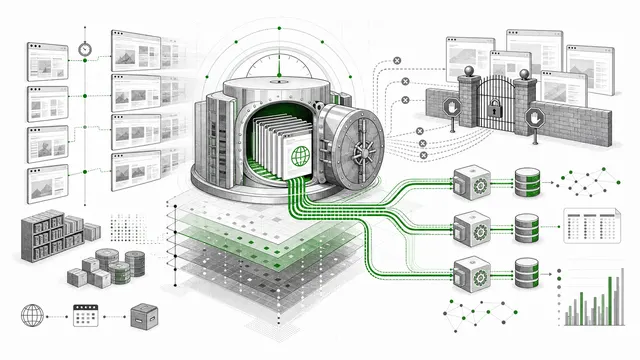

The Wayback Machine — Internet Archive’s web-archive project, founded 1996 — was never built as scraping infrastructure. By 2026, that is functionally what it is for a meaningful share of the scraping ecosystem. The CDX API returns point-in-time HTML for arbitrary URLs at zero marginal cost to the requester. Scrapers that target historical data, low-volume current data, or data on sites with aggressive anti-bot defenses lean on archive.org as a hidden CDN that the target sites cannot rate-limit.
The dependency is asymmetric. Internet Archive operates on a $10-15mn annual budget and a permanent state of legal pressure from rights-holders. The scraping ecosystem treats the service as durable infrastructure. Whether the infrastructure actually survives the funding and legal pressure is one of the most consequential open questions in the scraping landscape.
How scrapers use the archive
Three distinct use cases drive scraper traffic to archive.org’s CDX endpoint.
Historical data extraction. A researcher or commercial buyer wants the state of a page as it existed on a specific past date. Pricing pages from competitors, news article versions before takedowns, product catalogs from before the site redesigned. The Wayback Machine is the only source for this data — the original publisher does not provide it. CDX is the API that makes this programmatic.
Bypassing rate-limits on current data. A scraper targeting a low-volume current site (a small e-commerce store, a niche directory) can pull recent Wayback snapshots instead of hitting the live site directly. The snapshots are typically hours to days behind the live data, but for use cases where freshness within a week is acceptable, this trades off freshness for evading the publisher’s anti-bot stack entirely. The publisher never sees the scraper request.
Building historical datasets cheaply. Academic research projects and dataset builders use Wayback to construct longitudinal datasets — changes in website content over time, evolution of product pricing, language model training corpora that need historical web snapshots. The data is free; the cost is in the engineering to navigate the CDX API and reconstruct the historical state.
The Apify Store has actors that wrap Wayback CDX queries — a small segment, perhaps 30-50 actors in the tracked subset, but with disproportionate usage given the data-source breadth. The combined demand across these actors maps onto the historical-data and bypass use cases roughly equally.
The funding-pressure picture
Internet Archive operates as a 501(c)(3) nonprofit. Its 2024-2025 financial filings show roughly $10-15mn in annual revenue, primarily from individual donations and foundation grants. The organization runs the Wayback Machine plus the broader archive (books, films, software, audio) on this budget, with about 150-200 employees.
Three financial pressure points compound:
The Hachette v. Internet Archive ruling. The 2023-2024 court ruling against Internet Archive’s controlled-digital-lending program imposed costs and operational changes. The settlement terms (publicly disclosed in part) put ongoing financial strain on the organization. The Wayback Machine itself was not the subject of the lawsuit, but the financial impact spreads to all programs.
Bandwidth costs scaling with AI traffic. AI-crawler traffic to archive.org has grown sharply through 2025-2026. The same dynamic that pushed publisher CDN costs up has hit Internet Archive — and unlike publishers, Internet Archive has no monetization mechanism for the traffic. The cost is absorbed against a flat donation base.
Donation-base concentration. Internet Archive’s donation income depends on a small number of large gifts and a long tail of small ones. The large gifts are subject to single-donor whim; the long tail of small gifts has not grown proportionally to operational costs. The financial sustainability of the model under current cost trajectories is genuinely unclear.
The legal-pressure picture
Beyond Hachette, archive.org sits in an ongoing tension with publishers, rights-holders, and platform operators.
Music industry suit (2023-2024). Major labels filed against Internet Archive’s “Great 78 Project” — the digitization of 78-rpm records. The case adds further financial exposure.
Robots.txt compliance scrutiny. Internet Archive has historically respected robots.txt for new crawls but not for displaying already-archived content. Some publishers have demanded retroactive removal of archived content. The legal status of these demands is unresolved.
National-government access disputes. Multiple national governments have requested removal or modification of archived content. Internet Archive has resisted some of these requests, agreed to others. The geopolitical exposure compounds over time.
The legal environment does not threaten Wayback’s existence directly today, but it constrains how aggressively Internet Archive can defend its core mission. The organization is in a structurally weaker negotiating position in 2026 than it was in 2018.
What happens if Wayback degrades
If Internet Archive’s funding falls below operational threshold — or if a court ruling materially restricts Wayback’s crawl-or-serve operations — the impact on the scraping ecosystem runs in several directions.
Historical data becomes commercially valuable. The free supply of point-in-time HTML disappears. The scraping operations that depend on it either build their own historical archives (expensive) or pay commercial alternatives. Common Crawl is the closest substitute but covers different content with different freshness; it does not replace Wayback for most use cases.
Bypass scraping becomes harder. The scrapers using Wayback to avoid live-site rate limits would need to go directly. This either pushes them to pay for higher-cost commercial bypass (Bright Data Web Unblocker, similar) or accept the rate limits.
Academic and research uses lose primary tooling. A meaningful share of academic web research depends on Wayback. The alternatives are commercial datasets (Common Crawl, web archives operated by national libraries) that are less complete and less accessible.
The aggregate effect is that scraping infrastructure costs rise. The hidden subsidy that the Wayback Machine provides — letting commercial scrapers free-ride on a nonprofit-funded archive — disappears, and the costs surface explicitly in commercial pricing.
What scrapers should do now
For Apify Store publishers and other scraping operators currently depending on Wayback, the prudent posture is to plan for degradation, not depend on continuity.
Diversify historical-data sources. Cache historical snapshots locally rather than relying on Wayback to keep serving them. The marginal cost is non-trivial but the strategic optionality is worth it.
Reduce hidden-CDN usage. Where Wayback is being used to evade live-site rate limits, the long-run answer is to pay for direct access through commercial bypass services. The pricing has come down (cost-per-1000-pages benchmark) enough that this is increasingly viable.
Donate to Internet Archive. A few hundred to a few thousand dollars from each commercial scraping operator that depends on the service would materially improve the financial picture. This is mostly not happening. The funding gap is partly a free-rider problem in the commercial scraping ecosystem.
The longer-term reading is that the Wayback Machine has been an unrecognized piece of scraping infrastructure for two decades. The recognition will come either when the service degrades (forced acknowledgment) or when the commercial operators that depend on it decide to fund it (voluntary acknowledgment). The first scenario is more likely than the second.
Sources
- Internet Archive financial reports
- Wayback Machine CDX API documentation
- Hachette v. Internet Archive ruling overview
- Apify Store — Wayback-wrapping actor segment
- Signal Census: Cost per 1,000 Pages Benchmark — commercial-pricing baseline