ZoomInfo's De-Rating Is the Scraper Thesis
ZoomInfo (now GTM) guided to a roughly 4% 2026 revenue decline, cut about 600 jobs, and trades 96% below its 2021 peak. The de-rating reads as the market pricing in $1.50-per-1,000 lead scrapers and Clay-style substitution.
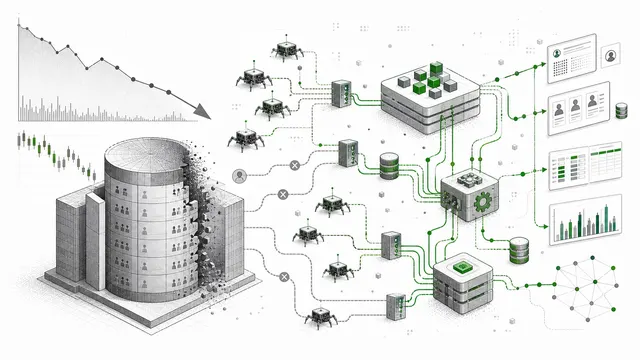
ZoomInfo cut its full-year 2026 revenue guidance to a range of $1.185bn to $1.205bn on May 11, implying a roughly 4% year-over-year decline, and said it would eliminate around 600 roles — 20% of its workforce. The stock fell 32.78% the next session to close at $4.06, and by late May traded near $3.38, a market capitalisation of about $0.99bn. For a company that priced its 2020 IPO at $21 and peaked at $77.35 in November 2021, the message from the market is blunt: the premium B2B-contact-data moat is being repriced as a commodity.
That repricing is the scraper thesis made visible on a public income statement. ZoomInfo built a multi-billion-dollar business selling structured contact and company data — names, titles, direct dials, emails, intent signals — at enterprise seat prices that started around $15,000 a year and routinely ran far higher. The bet now embedded in the stock is that most of that data can be assembled, on demand, by cheap scrapers and re-enriched by anyone with an API key.
The numbers behind the guidance cut
The quarter itself was not a disaster. ZoomInfo reported Q1 2026 GAAP revenue of $310.2mn, up 1.5% year-over-year, with GAAP operating income of $57.9mn, adjusted operating income of $109.7mn, and a 35% adjusted operating margin. Non-GAAP diluted earnings came in at $0.28. This is not a company that has stopped making money.
What spooked the market was the trajectory. Dollar-based net revenue retention sat at 90% — the third consecutive quarter at that level, meaning the existing customer base is shrinking before any new logos are counted. Customers contributing $100,000 or more in annual contract value fell by 21 sequentially to 1,900. And the new full-year guide of $1.185bn–$1.205bn is a sharp cut from the $1.247bn–$1.267bn the company floated only three months earlier, when it reported full-year 2025 revenue of $1.249bn. Pomerantz LLP and other plaintiff firms opened investigations into the gap between February’s optimism and May’s reality.
What is actually eroding the moat
ZoomInfo’s own commentary names the threat. CFO Graham O’Brien told analysts that customers in the software vertical “experienced elevated rates of downsell and churn.” Chief executive Henry Schuck described “a pause in purchasing decisions” driven by “AI and agentic confusion” — buyers asking what they can build versus what they should buy. That build-versus-buy question is the entire scraper economy in one sentence.
The substitution menu has never been cheaper. On the Apify Store , B2B lead-generation actors now sell verified contact records with emails included at roughly $1 to $1.50 per 1,000 leads, and several market themselves explicitly as Apollo, Lusha and ZoomInfo alternatives. Dedicated LinkedIn profile scrapers run about $4 per 1,000 profiles. A buyer who needs 50,000 enriched contacts can assemble them for a few hundred dollars of usage-based spend, against a ZoomInfo contract whose published minimum is around $15,000 a year.
Tooling such as Clay sits one layer up, orchestrating those scrapers and enrichment APIs into automated go-to-market workflows — letting a revenue team rent the exact data it needs, per record, and skip the seat licence entirely. The marginal contact record, once a defensible proprietary asset, is now a metered API call.
A pricing model under structural pressure
ZoomInfo is not standing still, and its response confirms the diagnosis. The company changed its ticker from ZI to GTM in February, recasting itself as a “Go-To-Market Intelligence Platform,” and Schuck told investors that from Q3 customers will be able to “convert historical per-seat spend into consumption.” That is a managed retreat from the seat-based model that built the business, toward the same usage-based metering the scrapers already run on — a tacit admission that the old packaging no longer holds.
The restructuring math underlines the squeeze. Closing its Israel facilities and cutting 20% of headcount — about half of it in R&D — is expected to take roughly $60mn out of annual run-rate operating expenses. Even so, the company trimmed its 2026 adjusted operating income guide to $437mn–$447mn, down from the $456mn–$466mn it had floated in February, while holding non-GAAP EPS at $1.10–$1.12. Profitability is being defended through cost, because the top line cannot be defended through growth.
The read-through for the data economy
ZoomInfo is the cleanest public proxy for what cheap, abundant scraping does to a data incumbent: a 96% drawdown from peak, contracting retention, and a pivot toward usage-based pricing forced by tools that were usage-based from birth. The aggregate signal in the Apify Store — dozens of lead-gen and LinkedIn actors priced in dollars per thousand records — is not a niche curiosity. It is the supply side of the same shift that took $60mn of cost and three years of shareholder returns out of a once-premium franchise.
None of this means contact data has no value; ZoomInfo still earns 35% adjusted operating margins on $1.2bn of revenue. It means the value has migrated from owning a proprietary database to orchestrating commodity feeds, and the premium attached to the former is now visibly mortal. The market figured that out before the company rebranded.
ZoomInfo’s next disclosure will test whether usage-based pricing can stabilise net retention or merely formalises the discount. Either way, the de-rating has already named its cause.