SaaS Pricing Intelligence: 4 Vendors, 1 Commodity Market
Four vendors (Vendr, Tropic, Cledara, Spendflo) sell SaaS pricing intelligence. Vendr/Tropic on customer-panel data; Cledara/Spendflo lean on broader scraping plus customer signals. Market converging — same underlying contracts, same buyer profile, similar recommendations.
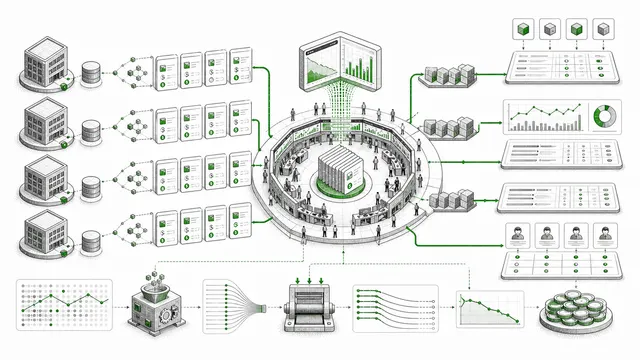

Four vendors dominate the SaaS pricing-intelligence market in 2026: Vendr, Tropic, Cledara, and Spendflo. All four sell substantially the same product — pricing benchmarks and negotiation support for enterprise SaaS contract purchases — to substantially the same buyer (procurement teams at mid-market and enterprise companies). The data inputs differ; the buyer-facing recommendations are converging.
The structural question for the segment is whether the four vendors continue to differentiate on data inputs (customer panels vs scraping) or whether the segment commoditizes around a single shared dataset. The economic forces point at commoditization. The buyer outcome — “what should I pay for Salesforce Sales Cloud next year” — does not change based on whose pricing-intel vendor produces the recommendation, because the underlying SaaS contracts are the same.
The four vendors and their data sources
Vendr. Largest in the segment, ~$15-25mn ARR. Data source is primarily its own customer-panel: thousands of SaaS contracts purchased through Vendr’s negotiation service, aggregated into pricing benchmarks. Strong on actively-negotiated categories (Salesforce, AWS, Slack, ZoomInfo) where customer-panel volume is high; weaker on long-tail SaaS where the panel is thin.
Tropic. Smaller than Vendr but adjacent in approach. Customer panel plus partnerships with SaaS vendors for direct pricing-list visibility. Stronger on enterprise mid-market segment; less coverage of true enterprise tier.
Cledara. Different angle — focused on SaaS-spend-management for smaller companies (50-500 employees). Pricing intelligence is a feature of the broader spend-management product, not the primary sale. Data source is customer billing data plus public-pricing-page scraping for benchmarking.
Spendflo. Newer entrant, growing fast in late 2024-2026. Combines customer-panel data with active scraping of public SaaS pricing pages plus partnerships with category-specific consultants. The most scraping-dependent of the four.
The differentiation across the four currently maps roughly to: Vendr for actively-negotiated enterprise SaaS, Tropic for mid-market, Cledara for SMB spend management, Spendflo for broader scope at competitive pricing. The categorization is real today but is the kind of segmentation that tends to collapse as vendors expand into adjacent buyer cohorts.
Where scraping fits
For the SaaS pricing-intelligence segment specifically, the scraping component is large but not the primary value-add.
Public pricing page scraping. All four vendors maintain ongoing scrapers against the published pricing pages of major SaaS vendors. The data is publicly available but the maintenance cost is real — pricing pages change frequently, the layouts vary across thousands of vendors, and the discovered “price” rarely matches what the customer actually pays. The scraping is necessary but not sufficient.
Customer-disclosed-contract scraping. Some intel comes from G2 reviews, Capterra listings, public earnings calls, RFP responses leaked to the web, and similar sources. Vendors actively scrape these surfaces and synthesize the discoverable signals.
RFP and quote-document scraping. Where customers permit it, the intel vendors ingest the RFP responses and quote documents that customers receive from SaaS vendors. This is the highest-quality data source but depends on customer willingness to share it.
The aggregated pricing dataset that emerges across these sources is meaningfully better than what any individual procurement team could assemble. The customer-panel-derived data (real negotiated prices) is the most valuable component because it captures the actual market clearing prices, not the list prices.
What the segment is converging toward
Three forces drive segment convergence over the next 24 months.
Customer-panel data accumulates everywhere. As each of the four vendors signs more customers, the relative-data-advantage of the panel-leaders (Vendr) erodes. The smaller vendors’ panels grow large enough to produce statistically meaningful benchmarks for the most-traded SaaS categories. The differentiation that “Vendr has more data” supported through 2024-2025 stops holding by 2027.
SaaS vendor-side pricing data becomes more transparent. Pressure on SaaS vendors to publish more pricing information (from procurement teams, from regulatory pressure on SaaS contract opacity, from buyer-side benchmark publication) is increasing. As more SaaS vendors publish enterprise pricing tiers, the scraping value-add shrinks because the data is on the vendor’s own page.
LLM-assisted negotiation support. The pricing-intel vendors are starting to ship LLM-powered tools that help procurement teams draft contract responses, analyze quote documents, and structure negotiation. The data is the input; the negotiation support is the output. As the LLM-tooling layer matures, the differentiation moves from “whose data is better” to “whose negotiation tooling is better.” The data layer commoditizes; the tooling layer becomes the new battleground.
What it means for Apify publishers
For Apify Store publishers building SaaS-pricing-data scrapers, the segment dynamics offer a specific opportunity.
The wholesale-data-primitive role applies here. A high-quality scraper covering G2, Capterra, public pricing pages, and SaaS-vendor change-tracking is a viable wholesale input to the pricing-intel segment. The four vendors above all need data they do not collect themselves and would buy if the supply existed at the right price.
The aggregation tier is the buyer. Selling individual SaaS-pricing scrapes to procurement teams directly is structurally hard — the buyer needs synthesis and recommendation, not raw data. The buyer who wants raw data is the next layer up: the intel vendors who assemble it into recommendations.
Schema discipline matters more here than in many segments. SaaS pricing data is messy — every vendor structures their pricing pages differently, the “edition” vs “tier” vs “seat” terminology varies, and the unit-of-comparison is non-obvious. An Apify scraper that delivers normalized, schema-disciplined output (vendor name canonical, tier-name standardized, per-seat-equivalent price extracted, contract-term normalized) is far more valuable than one that returns raw scraped fields.
The longer-term shape of the SaaS pricing-intelligence segment will look like the labor-intel wholesale and property-data wholesale markets: a small number of dominant analytics vendors, each running on top of scraping-plus-customer-data inputs, competing on the analytical and tooling layer above the underlying data. The Apify Store role is the wholesale data primitive — high-quality, well-maintained scrapers that the analytical vendors buy from.
By Q4 2027, expect either a meaningful consolidation among the four (one or two acquisitions, the others struggling) or the entry of a fifth credible vendor built on the LLM-tooling-first thesis with a thinner data layer. The 4-vendor market structure is not stable beyond that horizon.
Sources
- Vendr
- Tropic
- Cledara
- Spendflo
- Signal Census: Labor-Intel Wholesale Stack — adjacent market structure
- Signal Census: RealtyMole, ATTOM, CoreLogic Property Data — adjacent market structure