ARR-per-Employee: Scraping Vendor Productivity Ranked
Across eight scraping vendors, ARR-per-employee spans roughly $400k (small-team SaaS) to $1.5mn (Bright Data, infrastructure-leveraged). The 3-4× spread tracks software-vs-services mix. Lowest tier sits where enterprise-services revenue is still the model.
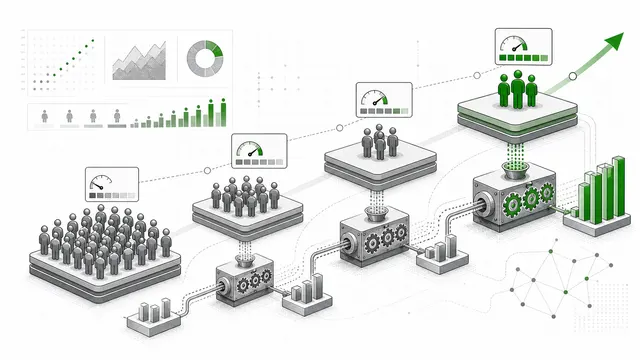


Across the eight scraping vendors with publicly-estimable ARR and LinkedIn-trackable headcount, ARR-per-employee ranges from roughly $400k at the small-team SaaS end to $1.2-1.5mn at Bright Data’s operating-model end. The 3-4× spread is structurally meaningful — it tracks how much of the business is software (high leverage) versus services (low leverage), and predicts which vendors can sustain growth without proportional hiring.
The metric is approximate. ARR estimates for private companies are triangulated from announcements, leaks, and pricing-card math. Headcounts are LinkedIn-reported, which under-counts contractors and over-counts inactive accounts. But the order-of-magnitude ranking is informative even with these caveats, and the productivity tiers it surfaces predict who can compress costs in the next downturn and who has to keep hiring to keep growing.
The productivity ranking
Public-estimable ARR and headcount as of Q2 2026, ranked by ARR-per-employee:
| Vendor | Est. ARR | LinkedIn FTE | $ ARR/FTE | Operating mode |
|---|---|---|---|---|
| Bright Data | ~$300mn | ~200 | Highly automated, residential-IP infrastructure as core asset | |
| Apify | ~$25-30mn | ~50 | Marketplace + platform, low support-touch | |
| ScrapingBee | ~$10-15mn | ~15-20 | Tight SaaS, single product | |
| Firecrawl | ~$8-12mn | ~20 | Recently funded, hiring scale-up phase | |
| ZenRows | ~$8-10mn | ~25 | SaaS plus growing services tier | |
| Scrapfly | ~$6-8mn | ~12-15 | Founder-led, tight team | |
| Browserbase | ~$20-30mn | ~50-60 | Infrastructure-heavy, browser-as-a-service | |
| Zyte (ex-ScrapingHub) | ~$30-40mn | ~150-200 | Enterprise services + platform, high-touch |
Bright Data leads the table by a wide margin. The $1.5mn-per-employee number reflects a business model that has been heavily automated — the residential-IP network operates with limited human intervention per transaction, and the data-product side scales on infrastructure rather than headcount. Apify’s $500-600k reflects the marketplace pattern: most of the actor-running labor is publisher-side, not Apify-side.
Zyte sits at the bottom because the enterprise data-extraction model is structurally services-heavy. A six-figure annual contract with a Fortune 500 buyer typically includes dedicated account management, custom-extraction engineering, and SLA-backed support — all human labor. The ARR is real but the leverage on that ARR is weaker than the platform vendors.
What the spread reveals
Three structural factors drive the ARR-per-employee differences.
Software vs services mix. A pure SaaS vendor (ScrapingBee, Scrapfly) operates near the top of the productivity range because the marginal customer requires marginal software, not marginal humans. An enterprise services vendor (Zyte) operates near the bottom because the marginal contract requires marginal account managers, engineers, and support. The mid-tier vendors (Browserbase, ZenRows) sit between the two.
Infrastructure as the leverage point. Bright Data’s $1.5mn-per-employee is partly explained by the residential-IP network — the company has built a piece of infrastructure that operates at significant scale without proportional labor. Equivalent infrastructure-leveraged businesses (Cloudflare, Fastly) hit similar ratios. Apify gets some of this benefit from the platform model (publishers do the labor of building actors), but less than Bright Data because the marketplace requires more platform-side curation.
The hiring cycle. Firecrawl’s $400-600k reflects a company in the post-Series-A hiring phase, where headcount grew faster than ARR in the 6-12 months after the round. A static read of this ratio understates the company’s actual productivity, because the new hires are not yet contributing fully to ARR. By Q2 2027, this ratio will either climb (productive hires) or hold flat (over-hiring).
What it predicts
The ARR-per-employee ranking is a useful predictor of three forward-looking dynamics.
Downturn resilience. A vendor at $1.5mn-per-employee can absorb significant pricing pressure without hitting unit-economics breakeven. A vendor at $200-300k-per-employee has much less buffer. In a 2024-style funding-environment compression, the top of the table survives compression; the bottom has to either re-platform or accept margin collapse.
Growth ceiling without hiring. A vendor that can serve incremental customers without proportional hiring grows revenue faster than expenses. A vendor that has to hire to serve incremental customers grows revenue at the same rate as expenses. Over 3-5 years, the difference compounds dramatically. Bright Data’s growth trajectory ($85mn ARR in early 2024 to $300mn by Q1 2026) reflects an operating model that can scale revenue 3.5× while headcount grew roughly 2×.
M&A attractiveness. Strategic and PE acquirers value high ARR-per-employee businesses at higher multiples because the operating leverage is already embedded. A $30mn-ARR Zyte at 150 employees is a different acquisition target than a $30mn-ARR business with 40 employees — same revenue, very different post-acquisition margin trajectory. The PE-rollup activity in the data-vendor space in 2025-2026 has consistently targeted the high-productivity end of this table.
Where Apify sits
The $500-600k-per-employee number for Apify is in the middle of the spread — better than Zyte and Browserbase, worse than ScrapingBee and Bright Data. The position reflects the marketplace’s economic shape: most of the value-creation work is done by publishers, not by Apify employees, which gives Apify high leverage on the platform-fee revenue. But the platform-side investment (developer tools, MCP integration, payment rails, customer support) still requires meaningful headcount, which caps the per-employee ratio below the pure-infrastructure tier.
The structural opportunity for Apify to climb the productivity table runs through two moves:
Increased automation in publisher support. A meaningful share of Apify’s headcount is engaged in support for actor publishers — debugging, schema-validation help, payment-resolution. LLM-augmented support tooling could compress this materially in 2026-2027.
Higher-margin platform features. The MCP-era distribution of actors and the x402 payment rails are both high-margin platform features that grow ARR without proportional headcount. The more revenue that flows through these channels rather than through traditional console-driven actor purchases, the higher the per-employee productivity climbs.
The bottom of the productivity table is the warning. Zyte at $200-265k-per-employee is not a failing business — it serves enterprise customers, has real ARR, has logos. But the operating leverage is structurally limited, and in a market where competing vendors operate at 4-5× the productivity, the long-run cost of continuing to compete in the same buyer segment without re-platforming the operating model is significant.
The vendors at the top of the table — Bright Data, ScrapingBee, Apify, Firecrawl — are the ones that can compress costs in a downturn, grow faster in an upturn, and command higher acquisition multiples in any scenario. The vendors at the bottom have to choose between accepting permanently weaker unit economics or making the Zyte-style up-market move toward an even higher-margin enterprise segment that justifies the headcount cost.
Sources
- Apify investor page
- Bright Data company announcements
- Crunchbase scraping-vendor profiles
- LinkedIn headcount data (vendor company pages)
- Signal Census: Bright Data $300mn ARR — anchor for top vendor data
- Signal Census: Reworkd Shutdown — recent failure-mode in the segment